Wednesday, June 29, 2022

I Am 4 VHO: New Approach to Improve Seamless Vertical Handover in Heterogeneous Wireless Networks

 #heterogeniousnetwork #computernetwork #network #VerticalHandover #ANDSF


I Am 4 VHO: New Approach to Improve Seamless Vertical Handover in Heterogeneous Wireless Networks


Omar Khattab and Omar Alani, University of Salford, UK


https://airccse.org/journal/cnc/5313cnc04.pdf


Tuesday, June 28, 2022

A Class-based Adaptive QoS Control Scheme Adopting Optimization Technique over WLAN SDN Architecture

A Class-based Adaptive QoS Control Scheme Adopting Optimization Technique over WLAN SDN Architecture

Authors

Pacharakit Vanitchasatit and Teerapat Sanguankotchakorn, Asian Institute of Technology, Thailand

Abstract

Recently, Software-Defined Networking (SDN), a network architecture approach that enables the network to be intelligently and centrally controlled by using software applications, has been introduced. Another important issue in the network management context is Quality of Service (QoS). This work investigates the QoS provisioning of various traffic classes on an SDN-enabled network. We propose and implement the class-based adaptive QoS control scheme on SDN-enabled network for various traffic classes, namely VoIP, Video Streaming and File Transfer. The effectiveness of our proposed scheme is validated by simulation using Mininet and Ryu controller. The procedure to create the simulation platform and all details relevant to all software used are described step-by-step in detail. The main performance evaluation metric is the Maximum Number of Traffic Flows admittable with QoS while Average Throughput, Latency, Jitter, and Packet Loss Rate are maintained at the comparable level of the existing work in the literature called JMABC [11]. Our simulation results are illustrated with 95% confidence interval. According to the simulation results, it is obvious that our proposed class-based adaptive QoS control scheme adopting the optimization technique significantly outperforms the existing similar QoS provision scheme in terms of the maximum number of the high priority traffic flows (VoIP) admittable with QoS while the other evaluation metrics are maintained at the same level.

Keywords

Software-Defined Networking (SDN), Quality-of-Service (QoS).

https://aircconline.com/ijcnc/V14N3/14322cnc04.pdf 


Tuesday, May 31, 2022

Constellation Shared Multiple Access - A Noma Scheme for Increased User Capacity in 5G MMTC

Constellation Shared Multiple Access - A Noma Scheme for Increased User Capacity in 5G MMTC


Authors

Kiran V. Shanbhag1 and Savitha H. M.2, 1Anjuman Institute of Technology and Management, India, 2St Joseph Engineering College, India


Abstract

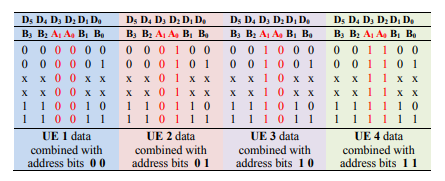
While the legacy cyclic prefix orthogonal frequency division multiple access is retained as the preferred multiple access scheme for 5G enhanced mobile broadband the research is now focussed on the multiple access schemes for massive machine type communication (mMTC) and ultra-reliable low latency communication .Though orthogonal multiple access schemes provide simple reception, they limit number of simultaneous user equipment as against the primary requirement of mMTC. On the other hand, the various non-orthogonal multiple access schemes which have been proposed so far as the likely solution, need complex successive interference cancellation receivers. So a simplified scheme named constellation shared multiple access is proposed here which substantially increases the number of simultaneous users to be served within a single resource block (RB) in LTE or 5G New Radio, thus aiding the massive connectivity requirement of mMTC. This is achieved by differentiating among the users in constellation domain. Moreover, the simple architecture compatible with 5G eMBB makes it a strong contender multiple access contender for 5G mMTC.


Keywords

Non orthogonal multiple access, Quality of service, Massive connectivity, 5G, Successive interference cancellation receiver, mMTC.


https://aircconline.com/ijcnc/V14N3/14322cnc05.pdf


Wednesday, May 25, 2022

#MQTT #network #DoSAttack #iot
Performance Evaluation of Different Raspberry Pi Models as MQTT Servers and Clients

Authors
Trent N. Ford, Eric Gamess and Christopher Ogden, Jacksonville State University, USA

Abstract
Performance analysis for devices in Internet of Things (IoT) environments is an important consideration, especially with their increasing integration in technological solutions, worldwide. The Single Board Computers (SBCs) of the Raspberry Pi Foundation have been widely accepted by the community, and hence, they have been incorporated in numerous IoT projects. To ease their integration, it is essential to assess their network performance. In this paper, we made an empirical performance evaluation of one of the most popular network protocols for IoT environments, named the Message Queuing Telemetry Transport (MQTT) protocol, on Raspberry Pi. To do so, we set up two different testbeds scenarios and assessed the performance with benchmarks. At the software level, we focused on Mosquitto, a popular open-source MQTT broker implementation and client library. Our principal metric is the transmission time, but we also investigated the throughput. In our experiments, we varied several parameters, such as the size of the payload of the published messages, the WiFi bandwidth, the QoS level, the security level (MQTT vs. MQTT with TLS), and the hardware for the clients and broker. We focus mainly on packet sizes ranging from 100 to 25,000 bytes. We also investigate how these low-cost devices handle a TCP SYN flood attack. In the research work presented within this paper, we aim to guide developers, researchers, network administrators, and hobbyists who plan to use these low-cost devices in an MQTT or IoT network by showing the performance that they should expect according to different Raspberry Pi options.

Keywords
MQTT, Mosquitto, Benchmark, Performance Evaluation, Raspberry Pi, DoS Attack.

https://www.youtube.com/watch?v=LGEy6ePOSkE&list=PLpTbECDq5OWA7YEHmDZxLz6DDrmjDc7r3

Wednesday, July 29, 2020

LOCALIZATION SCHEMES FOR UNDERWATER WIRELESS SENSOR NETWORKS: SURVEY

Faiza Al-Salti1 , N. Alzeidi2 and Khaled Day2

1Department of Computing, Muscat College, Oman

2Department of Computer Science, Sultan Qaboos University, Oman

Abstract 

Underwater Wireless Sensor Networks (UWSNs) enable a variety of applications such as fish farming and water quality monitoring. One of the critical tasks in such networks is localization. Location information can be used in sensor networks for several purposes such as (i) data tagging in which sensed information is not useful for the application unless the location of the sensed information is known, (ii) tracking objects or (iii) multi-hop data transmission in geographic routing protocols. Since GPS does not work well underwater, several localization schemes have been developed for UWSNs. This paper surveys the state-ofthe-art of localization schemes for UWSNs. It describes the existing schemes and classifies them into different categories. Furthermore, the paper discusses some open research issues that need further investigation in this area.

Keywords 

Underwater Wireless Sensor Networks, Localization, Ranging Methods, Positioning, Range-based &Range-free.                  

                                                  Full Text

Tuesday, July 21, 2020

SIGNALING PROTOCOLS FOR LOCAL AREA NETWORKS OF DRONES

Prabhu Jyot Singh and Rohan de Silva

School of Engineering and Technology CQ University Sydney, Australia

Abstract 

Unmanned Aerial Vehicles (UAVs) or drones have become extremely popular and are used in various commercial applications. When multiple UAVs communicate and work together, they form a UAV network. A private UAV network or Local Area Network of Drones (LoDs) is a special type of UAV network which has the minimum number of UAVs to carry out a certain task. All UAVs in a LoD use the wireless medium to send and receive the data as well as the control signals. An organization or a single owner will be more interested in this type of network, where they want multiple UAVs to scan an area, communicate with each other, and send all the images and live video streams to a single ground station. The currently available commercial UAVs Can send the video signals to and receive control signals only from their own ground station controllers. However, in an LoD network where UAVs are connected in tandem, the UAVs that are in the middle of the network have to carry the control and video signals of other UAVs. Given the limited processing power and dynamic memory capacity of UAVs, this would increase the queuing delays and performance. In this paper, we study the frame formats of existing control, feedback, and data messages of commercial AR UAVs and propose a new approach to construct the payloads of control and feedback frames that are suitable for an LoDs. We compare the performance of our approach of single control and feedback frame for all UAVs in a LoD branch with that of separate control and feedback frames for each UAV. We calculate and compare the UAV node processing delay in both types of signaling mechanisms and show that the single control and feedback frame signaling has less delay on the average.

Keywords 

UAV communication, Private UAV Network, LANs of Drones, Signaling Frames, Control and feedback singling                     

                                                  Full Text

Wednesday, July 8, 2020

ENERGY-EFFICIENT MULTI-HOP ROUTING WITH UNEQUAL CLUSTERING APPROACH FOR WIRELESS SENSOR NETWORKS

Younes El Assari , Samia Al Fallah, Jihane El Aasri, Mounir Arioua and Ahmed El Oualkadi

Laboratory of Information and Communication Technologies, National School of Applied Sciences, Abdelmalek Essaadi University, Tangier, Morocco

Abstract 

The development of an energy-efficient routing protocol, capable of extending the life of the network, is one of the main constraints of wireless sensor networks (WSN). Research studies on WSN routing prove that clustering offers an effective approach to prolong the lifetime of a WSN, particularly when it is combined with multi-hop communication that can reduces energy costs by minimizing the distance between transmitter and receiver. Most clustering algorithms using multi-hop in data transmission encounter the hotspot problem. In this work, an Energy-efficient Multi-hop routing with Unequal Clustering approach (EMUC) is proposed, to create clusters of different sizes, which depend on the distance between the sensor node and the base station. Equilibrate the energy dissipation between the cluster heads is the purpose of this approach by adopting multi-hop communication to relay data to the base station. The implementation of multi-hop mode to transmit data to the base station reduces the energy cost of transmission over long distances. The effectiveness of this approach is validated through performed simulations, which prove that EMUC balances energy consumption between sensor nodes, mitigates the hotspots problem, saves more energy and significantly extends the network lifetime.

Keywords 

Energy-efficient, Hotspot issue, Routing protocols, Unequal clustering, Wireless sensor networks, Multihop communication                      

                                                  Full Text